Nice Try, But Even This is Better


Hosted by 
Thanks to past GTxA hosts: the Center for Research in Computing and the Arts and the School of Literature, Communication, and Culture.
http://grandtextauto.org
is the shortest way to get to this blog.
Of my “Taroko Gorge”:
“Take Ogre” by John Pat McNamara, remixed Febuary 16, 2013 on Achill Sound, Ireland. The piece trades off the images of the natural world for language of the mind, and sports a nice recursive background. (View source for some further information in a comment up top.) Thanks to publisher Michael J. Maguire for noting this remix in a comment here.
“TransmoGrify” by Leonardo Flores of I ♥ E-Poetry, published in Springgun Press Journal, issue number 8. (There’s a note on the piece in the journal.) This one is also about contemplation and mental work, endlessly describing the process of remixing “Taroko Gorge.”
I have two new digital pieces (one a collaboration) that have just been published by James O’Sullivan’s New Binary Press:
Round is a computational poem that is non-interactive, deterministic, and infinite (boundless), since it simply substitutes text fragments for the digits 0-9 and presents a representation of the digits of pi. See the note for further information, and if the concept intrigues you at all, please, run the piece for a while.
If you visit this page on the Worl, you may wonder how to read it.
Now, if you just click on that link, you’ll be taken to that page on the Web. To get to the Worl page, you’ll need to install The Deletionist bookmarklet and, once you get to the Web page, click on it. If the page is exactly the same as when I viewed it (it may change, as it’s a wiki front page) you can be sure that your Worl page looks the same as mine did — we’re both looking into the same Worl.
Here’s one of many amazing pages on, not the World Wide Web, but The Worl: http://www.poetryfoundation.org/learning/guide/236558
(You need to install and activate The Deletionist to see it correctly…)
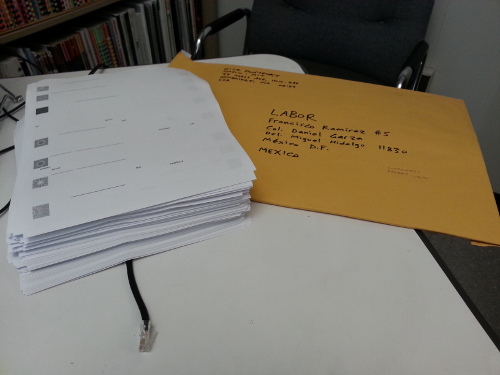
The Internent isn’t just the Web; it’s also telnet, Gopher, email … and the Worl. Here are 500 pages of the Worl that I printed out and mailed today to Kenneth Goldsmith’s exhibit, Printing Out the Internet.
The Worl is accessible to anyone who has a recent Web browser and has installed The Deletionist.
 I’m pleased to announce the release of a project that I’ve been working on with Amaranth Borsuk and Jesper Juul for the past two years: The Deletionist. This is a bookmarklet (easily added to the bookmark bar in one’s browser) that automatically creates erasure poetry from any page on the World Wide Web, revealing an alterate mesh of texts called the Worl. Amaranth and I presented The Deletionist for the first time today at E-Poetry in London, at Kingston University.
What miracle is this? This giant tree.
It stands ten thousand feet high
But doesn’t reach the ground. Still it stands.
Its roots must hold the sky.
O
HYMEN! O hymenee!
Why do you tantalize me thus?
O why sting me for a swift moment only?
Why can you not continue? O why do you now cease?
Is it because, if you continued beyond the swift moment, you would soon certainly kill me?
[This “House of Leaves of Grass” is a 24K poetry generator that produces about 100 trillion stanzas. Vast, it contains multitudes; it is bigger on the inside than it is on the outside. By Mark Sample, based on “Sea and Spar Between.”]
One classic downfall deserves another: Hitler reacting to the cancellation of Google Reader.
In this episode of Poetry Corner with Guido, Guido the python shares a Gertrude Stein poem titled Sacred Emily.
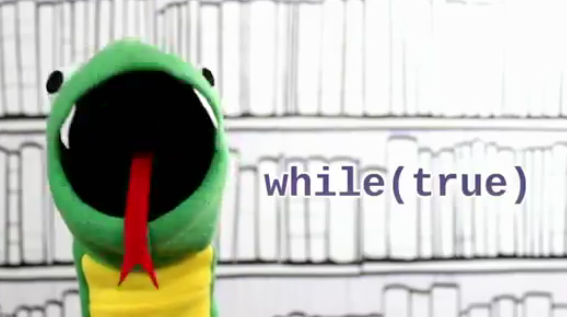
Jared Nielsen, thanks to his schooling in Modern and Contemporary American Poetry, his ability as a programmer, and his recent creation of a puppet, has developed an amazing conflation of Gertrude Stein, the Python programming language, and the Wonder Showzen episode “Patience.”
Nielsen has been recreating famous American poems in Python or so that they are about Python, as in “The Red Wheelbarrow” and “Song of Myself.”
Leonardo Flores has posted a nice discussion of Sea and Spar Between (by Nick Montfort and Stephanie Strickland) on his blog, I ♥ E-Poetry.
NLLF [Natural Language Liberation Front] · 296 pages
Leonardo Flores has now written 22 posts (one each day, as is his wont over at “I ♥ E-Poetry”) on Taroko Gorge and its various remixes.
Quite a critical outpouring, considering that Taroko Gorge was originally a one-day project!
Leonardo also presents TransmoGrify, another remix of Taroko Gorge that narrates the programming and remixing of these 22 poem generators, producing stanzas such as this one:
Mark inverts the line.
Sonny Rae experiments.
Judy intervenes upon the variable.
With the absolute ♥ of the e-poetry of life butchered out of their own bodies good to eat a thousand years.
Leonardo Flores has now written 22 posts (one each day, as is his wont over at “I ♥ E-Poetry”) on Taroko Gorge and its various remixes.
Quite a critical outpouring, considering that Taroko Gorge was originally a one-day project!
Leonardo also presents TransmoGrify, another remix of Taroko Gorge that narrates the programming and remixing of these 22 poem generators, producing stanzas such as this one:
Mark inverts the line.
Sonny Rae experiments.
Judy intervenes upon the variable.
With the absolute ♥ of the e-poetry of life butchered out of their own bodies good to eat a thousand years.
There’s lively discussion of the 10 PRINT book and the 10 PRINT program, 10 PRINT CHR$(205.5+RND(1)); : GOTO 10, (via the Slate review) over at Reddit. The Enterprise Java port of the program, contributed early on, is truly classic.
Sometimes I encounter language that sounds like it was computer-generated, or that sounds like it would be even better if it was. Hence, the slapdash “Lede,” which is based on the first sentence (no, not the whole first paragraph) of a news story that was brought to my attention on ifMUD.
This very simple system does incorporate one minor innovation, the function “fresh(),” which picks from all but the first element of an array and swaps the selection out so that it ends up at the beginning of the array. This means that it doesn’t ever pick the same selection twice in a row.
Ben Grosser created Facebook Demetricator, a tool that removes counts from Facebook, so that instead of displaying “14,836 people like this” your interface will simply say “people like this.”
I love the concept. I haven’t seen it in action myself, because of my use of a manually-implemented “DeFacebookizer” that, rather than enmeshing me in the most direct possible corporate system of social control and structure, leaves me with only the heterogeneous, diverse, and open communications from people on the World Wide Web. The Web is not a pure wonderland, though. These sorts of communications are, of course, also continually subject to statistical analysis and displays of counts – how many comments on a blog post, for instance. To intervene in the count-obsession of digital media, it makes sense to go to where it is most prominent.
Illya Szilak interviews Nick Montfort in the article “The Death of the Novel: How E-Lit Revolutionizes Fiction,” the first of a series of posts on electronic literature.
I was at a workshop in Bergen on Tuesday and a conference in Edinburgh Thursday through Saturday. There were many interesting things to report or at least mention, and I’ve only managed to note two of them on the blog so far. I’ll also mention that in Bergen, I did the first transverse reading of the full ppg256 series, reading through the seven generators’ output four times. I was very pleased with the art gallery setting, the other readings and screenings, and the way my reading went.
Jason Huff and Mimi Cabell did an excellent conceptual writing project, just presented at ELMCIP in Edinburgh.

“Rough Cuts: Media and Design in Process,” a set of “middle-state artifacts” curated by Kari Kraus, has just been presented as part of The New Everyday, a project at MediaCommons.
My contribution is a printout of “Taroko Gorge” in the original Klingon Python. I also offer some discussion of this printed page, representing one phase of a poetry generator that has been reworked and plundered more than a dozen times.
Among several notable new articles in ebr (electronic book review), please find “Shuffle Literature and the Hand of Fate” by Zuzana Husárová and Nick Montfort:
Zuzana Husárová and Nick Montfort up the ante for experimental writing by examining the category of “shuffle literature.” What is shuffle literature? Simply put: books that are meant to be shuffled. Using formal reading of narrative and themes, but also a material reading of construction and production, Husárová and Montfort show that there are many writing practices and readerly strategies associated with this diverse category of literature.

These are unedited search queries, all recorded in this sequence and all from the same “anonymized” user, on the evening of 2006-04-07. They were found in the user-ct-test-collection-03.txt, one of the leaked AOL search query files from 2006.
jaimiewantsahondacivic
www.iwantahondacivic.com
jaimiedeservessomethingthistime
mickisselfish.com
www.selfishhusbands.com
hondacivicshondacivicshondacivics
iwantahondacivic.com
hondacivicforjaimie
jaimiewantsahondacivicplease
if you love me then please buy me a civic
News of a strange new social network, Monolyth, reaches us from December of this year and from Chris McDowall.
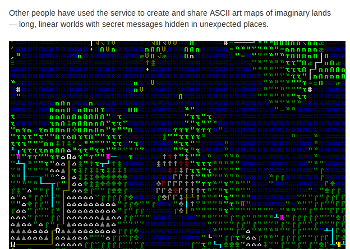
To sate the great appetites of the system, which will only publish messages at least 140,000 characters long (and will abbreviate longer ones), authors turn to unusual techniques.
One of these is generating massive texts using modified versions of Taroko Gorge, one of which is included in the blog post.
It’s not bigger and longer than Star Wars, but it is more uncut: “Death of the Author [Psycho Shower Scene RECON]“ by Dick Whyte. This, somewhat like the later famous Star Wars video, is a “reconstruction of Alfred Hitchcock’s famous shower scene from Psycho using amateur YouTube remakes.” 57 of them.
If you got that and you’re ready to increase the avant-garde, see also “John Cage – 4’33″ [May ’68 Comeback Special RECON]“ and “Andy Warhols Eat A Hamburger [38 Scenes From YouTube RECON].” All from 2010, but recalled here for your enjoyment.
Powered by WordPress