My Reading from #! at Google
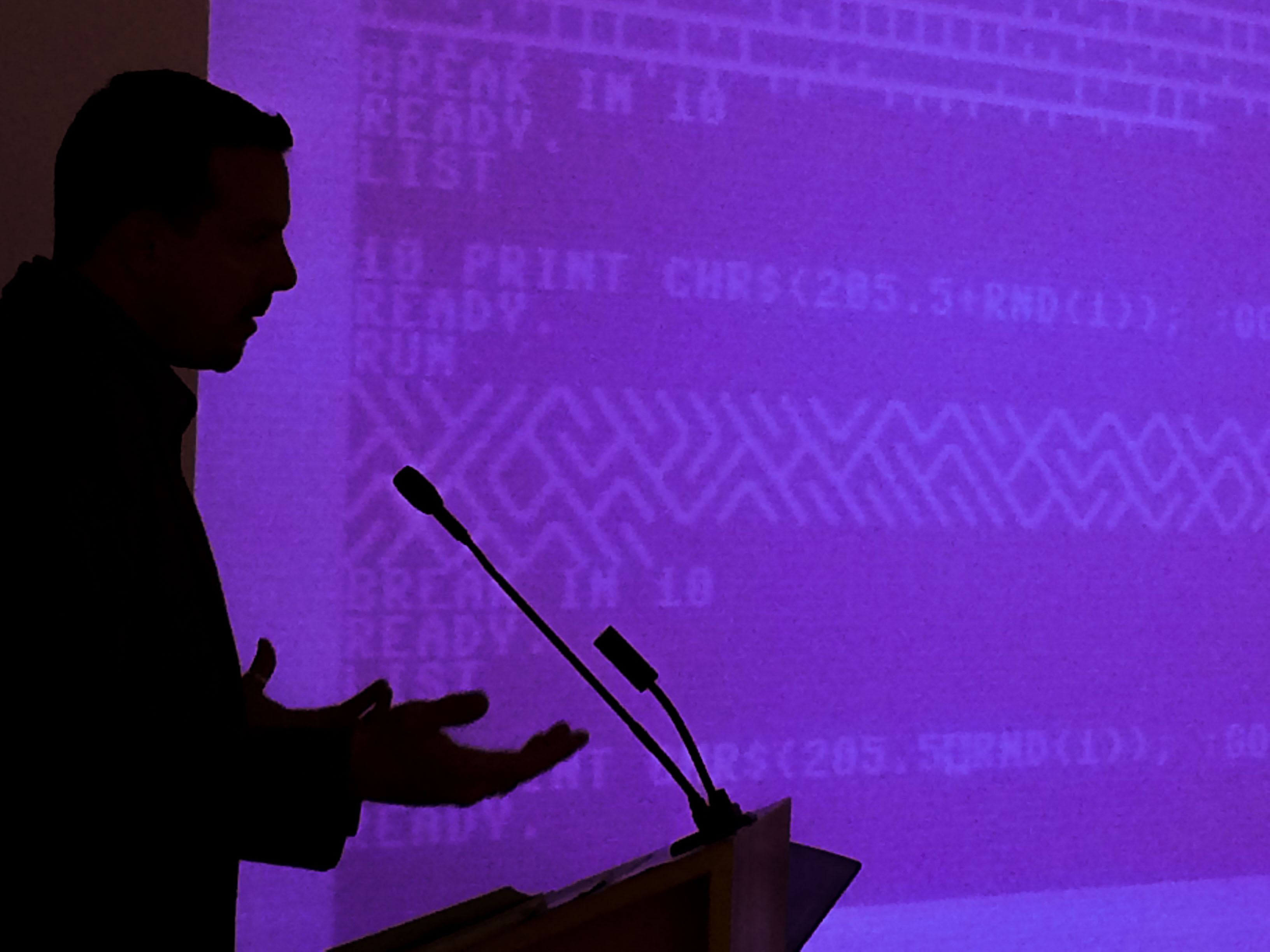
Video of my #! reading, which I did at Google Boston on December 2, is now online.
I actually forgot to present a few things. I’d wanted to at least show something from both Memory Slam and Renderings. Ah, well.

Hosted by 
Thanks to past GTxA hosts: the Center for Research in Computing and the Arts and the School of Literature, Communication, and Culture.
http://grandtextauto.org
is the shortest way to get to this blog.
Video of my #! reading, which I did at Google Boston on December 2, is now online.
I actually forgot to present a few things. I’d wanted to at least show something from both Memory Slam and Renderings. Ah, well.
For the past six months I’ve been working with six collaborators,
To translate e-lit, and for the most part computational literature works such as poetry generators, into English from other languages.
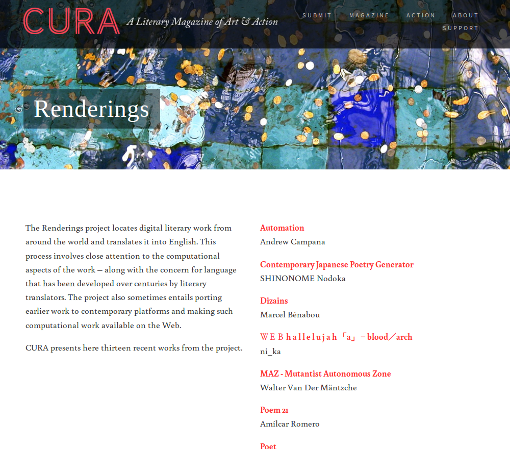
After a great deal of work that extends from searching for other-langauge pieces, through technical and computing development that includes porting, and also extends into the more usual issues assocaited with literary translation, the first phase of the Renderings project (13 works translated from 6 languages) has just been published in Fordham University’s literary journal, Cura.
… from the Harvard Book Store.
And if it’s digital data you’re craving, it’s also available for free as a PDF and as an EPUB. And the code that generated these books is free software.
Two pieces on my book #! have just come out in Galatea Resurrects (A Poetry Engagement), number 23.


Tiltfactor and the University of Edinburgh, Library and University Collections are excited to announce the addition of over 3,300 images from the University of Edinburgh to Metadata Games. This collection, a miscellaneous “gallimaufry” (a confused jumble or medley) of digitized items from Special Collections, displays the sheer variety and breadth of material held by the Centre for Research Collections.
Metadata Games is a free and open source (FOSS) crowdsourcing gaming platform that entices players to visit archives and explore humanities content while contributing to vital records. The suite enables archivists to gather and analyze information for digital media archives in novel and exciting ways. Metadata Games contains tens of thousands of media items from over 40 collections represented by 10 institutions.

On December 11, 2014 at 12pm EST, the Crowdsourcing Consortium for Libraries and Archives (CCLA) will hold its second 1-hour webinar titled, “Scoping and Funding Crowdsourcing Projects.” This webinar, hosted in conjunction with the OCLC, will explore how researchers, as well as libraries, museums and archives, interested in studying or using crowdsourcing techniques can seek funding for their ideas.
Crowdsourcing in the humanities is an emerging new area for museums, libraries, and archives. The CCLA was formed with the goal to unite leading-edge technology groups in libraries and archives as well as humanities scholars and scholars from the sciences in a conversation about best practices, shared toolsets, and strategies for using crowdsourcing.
Robert Pinsky writes the first installment, noting the recent death of poet Mark Strand.
I didn’t ever properly meet Strand, but I know many of his poems well and I went to one his art openings and saw him there. His work is mostly surrealist and nostalgic, not my usual cup of joe – and yet I found much of it quite appealing and memorable.
Zach Whalen pointed out that it would probably be interesting to compare the reimplementations of A House of Dust that he did early this year and that I did more recently. Whalen’s work to reimplement historical systems is really excellent, by the way, and I in fact showed his animated GIF of “Kick that Habit Man” when I premiered Memory Slam, including a workalike of Gysin and Sommerville’s program and my version of the Knowles and Tenney poem, at NYU ITP’s Code Poetry Slam.
Just as Pinocchio became a real boy, so Megawatt (my generated novel for NaNoGenMo 2014) has become a real book.
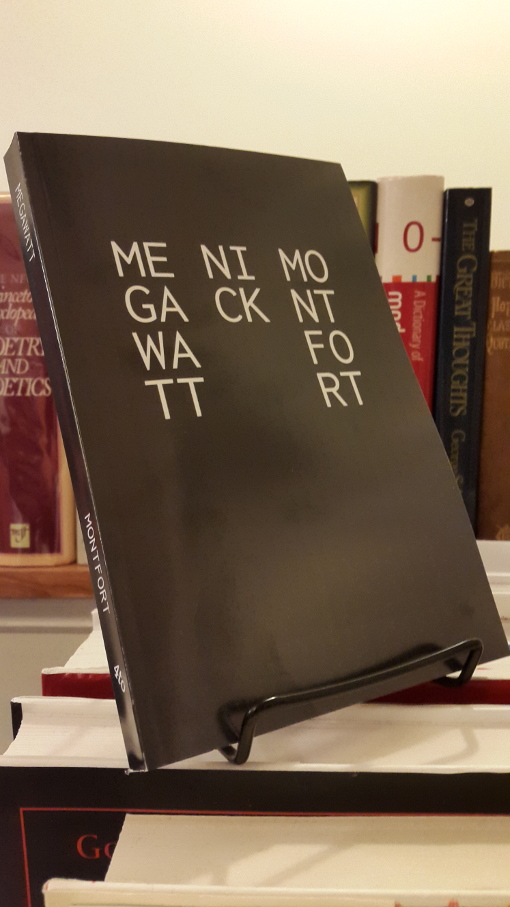
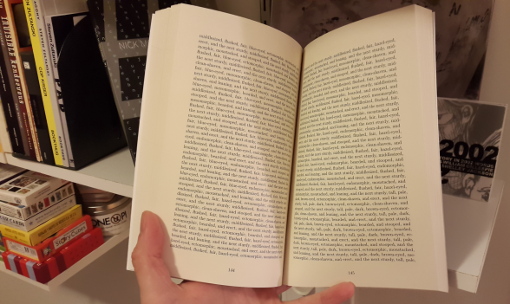
The book will be for sale within a few days from the Harvard Book Store.
It happened to some extent with LISP, which certainly started out as a software programming language, and the LISP machines, which supported the language with hardware features.
Now, the Z-Machine, which was probably the first commercial virtual machine, developed in 1979 by Joel Berez and Marc Blank for Infocom, has been implemented in hardware using an FPGA. The Verilog code is available, so you can make your own if you like.
It all goes to show you … there is no software.
To how software keeps getting better and graphics get better-looking on the same old consoles.
Note that for the Atari VCS / Atari 2600, only answers #3 and #4 apply, since developers didn’t use “engines” or even compilers, instead writing their code in assembly langauge. (Presumably the assemblers didn’t improve much over the years.) Also, the VCS had no firmware, flashable or otherwise; although refined versions of the hardware were produced over the years, such as the Atari 2600 Jr., such systems were optimized for cheaper manufacturing and didn’t improve performance.
Arts at MIT has a nice new article about my book #!, one that is very aptly titled. It’s by Sharon Lacey. I read from the book at the List Visual Arts Center at MIT on October 22.
My next reading, on December 2, will be at Google in the Authors@Google series.
There’s a nice article up at The Atlantic about Flash, written by the two authors of the new Platform Studies book, Anastasia Salter and John Murray. Their new book, I’ll remind you, is Flash: Building the Interactive Web.
The fruits of my National Novel Generation Month (NaNoGenMo) labors are now online; the Megawatt generator is available as a single 350-line Python file, while the novel it deterministically generates can be obtained as a PDF, megawatt.pdf or in epub format, megawatt.epub. From the program’s docstring and from the preface to the book:
Megawatt is the title of both a computer program, the source code
to which you may be reading, and the output of this program, which in
many ways like a standard novel and which you may instead be reading.
This note appears at the beginning of both.
I recently released Memory Slam, a set of four reimplementation of classic text generators. I did them over in JavaScript and in Python in the hopes that people would easily be able to play around with them, modify them, and understand them better through this sort of use. I’ve seen a few cases in which this has been done already, but first off, please let me know if you’ve posted modified versions of these, as I would love to see more. The license terms do not oblige you to do so, of course, they are licensed as free software. I’m just asking.
Some kind comments about World Clock and NaNoGenMo in the article “The Strange World of Computer-Generated Novels” by Josh Dzieza.
Nick Montfort’s World Clock was the breakout hit of last year. A poet and professor of digital media at MIT, Montfort used 165 lines of Python code to arrange a new sequence of characters, locations, and actions for each minute in a day. He gave readings, and the book was later printed by the Harvard Book Store’s press. Still, Kazemi says reading an entire generated novel is more a feat of endurance than a testament to the quality of the story, which tends to be choppy, flat, or incoherent by the standards of human writing.
I’m pleased to announce that the newly-formed Computational Media department at UC Santa Cruz is advertising an open-rank faculty position in interdisciplinary computer games research. As the official job flier puts it, our ideal candidate is someone “connecting novel technology research with practices of design and/or interpretation.”
I’m excited by the great community we’re building around games research, and computational media broadly, at UC Santa Cruz. This includes two key hires in the Arts this year (Robin Hunicke and Susana Ruiz) and the founders of the new MS in Games and Playable Media (Brenda Romero and John Romero) hired last year, as well as the pre-existing CM faculty (Arnav Jhala, Michael Mateas, Sri Kurniawan, Marilyn Walker, Jim Whitehead, and yours truly) and other faculty in the Center for Games and Playable Media (e.g., Brenda Laurel, Soraya Murray).
The People’s Republic of Interactive Fiction meets once again tomorrow (Monday 2014-11-24) in its regular meeting-place, the Trope Tank. We meet at 6:30 in MIT’s room 14N-233.
There is much to discuss and celebrate, such as the conclusion of the IF Comp – congrats to Sean M. Shore for his 1st place game Hunger Daemon, and to all the other winners. Besides that there’s the recent release of Hadean Lands by PR-IF stalwart Andew Plotkin. And, today there’s a front-page New York Times article about IF, and Twine games specifically. I’m sure I forgot some things we have to celebrate, so come by to see what those things are.
I’m doing two Central Texas readings from my book of programs and poems #! this weekend:
Friday, Nov 21 at 5pm
The Twig Book Shop
in The Pearl (306 Pearl Parkway, Suite 106)
Saturday, Nov 22 at 4pm
Monkeywrench Books
(110 N Loop Blvd E)
Today I’ll offer a discussion of porting and translation in computational art and literature at the ATNE Salon, Boston Cyberarts Gallery. The event’s at 7:30pm; the gallery is in the Green Street T Station, on the Orange Line in Jamaica Plain.
I’ll read from my book #! at the University of New Hampshire tomorrow: Memorial Union Building. 12:30pm.
You don’t have permission to access /memslam/IN A GREEN, MOSSY TERRAIN,IN AN OVERPOPULATED AREA,BY THE SEA,BY AN ABANDONED LAKE,IN A DESERTED FACTORY,IN DENSE WOODS,IN JAPAN,AMONG SMALL HILLS,IN SOUTHERN FRANCE,AMONG HIGH MOUNTAINS,ON AN ISLAND,IN A COLD, WINDY CLIMATE,IN A PLACE WITH BOTH HEAVY RAIN AND BRIGHT SUN,IN A DESERTED AIRPORT,IN A HOT CLIMATE,INSIDE A MOUNTAIN,ON THE SEA,IN MICHIGAN,IN HEAVY JUNGLE UNDERGROWTH,IN AN OVERPOPULATED AREA,BY A RIVER,AMONG OTHER HOUSES,IN A DESERTED CHURCH,IN A METROPOLIS,UNDERWATER on this server.
I was delighted to be at the first NYU ITP Code Poetry Slam a few hours ago, on the evening of November 14, 2014. The work presented was quite various and also very compelling. Although I had an idea of what was to come (as a judge who had seen many of the entires) the performances and readings exceeded my high expectations.
A reading I did from historical computational poetry kicked off the event. I read from a new set of reimplementations, in JavaScript and Python, that I developed for the occasion. The set of four pages/Python programs is called Memory Slam. It contains:
Powered by WordPress