January 4, 2006

Machinima Essays Wanted

from Grand Text Auto
by @ 4:05 pm

If there’s an essay on machinima you’ve been burning to write, now’s your opportunity. Henry Lowood and Michael Nitsche are editing The Machinima Reader, the first collection of essays to critically review the phenomenon of machinima from a variety of prespectives. 500 word abstracts should be sent as RTF files to Michael Nitsche (michael.nitsche@lcc.gatech.edu) and Henry Lowood (lowood@stanford.edu) by April 3, 2006. If your abstract is accepted, final essays should be 5000-7000 words and will be due July 2006. Here’s the full CFP:

Stretchtext Semi-Extended Remix

from Grand Text Auto
by @ 11:13 am

Years ago, early in the morning, I encountered a man in the Oslo train station who gave me a CD containing what might have been the sounds of a lake of robot jellyfish attaining a prolonged ecstasy, or perhaps plotting the overthrow of an oppressive regime [mp3, 971kb].

January 3, 2006

2005 Detritus, and Love from the Tunnel

from Grand Text Auto
by @ 3:16 am

Wait, before we say goodbye to 2005, let me quickly throw out a few extra links that shouldn’t be forgotten:

January 1, 2006

Beyond 2006

from Grand Text Auto
by @ 11:32 pm

Happy 2006, all! In the interests of being future-looking, I’ll start off the new year by looking right on ahead to 2007. In the fall of next year the incredible-sounding opera Death and the Powers will go on, with music by Tod Machover (of the MIT Media Lab; The Brain Opera, Resurrection), libretto by Robert Pinsky (Mindwheel, The Figured Wheel, Jersey Rain, The Favorite Poem Project), robotics engineering by Cynthia Breazael (MIT Media Lab), and production design by Alex McDowell (Minority Report, Fight Club, The Crow) – see the page for full credits and a link to a seven-page PDF description. The production will feature incredible-looking sets, autonomous robots, and hyperinstrumental music. The main character is Simon Powers, an aged inventor whose attempt at a seemingly extropian transformation is at the heart of the piece.

December 30, 2005

Wiktion and Poetri

from Grand Text Auto
by @ 1:44 pm

Chris Klimas, author of the interactive fictions Blue Chairs and Mercy, sends word of his TiddlyWiki-based site featuring nonlinear stories: Gimcrack’d. Chris is also accepting submissions of nonlinear stories for the site.

The Wikifiction proposal lists several other fiction-writing and fiction-oriented wikis. Where there are lightweight “personal” wikis such as TiddlyWiki and DidiWiki, the wiki has had widespread success as a tool for collaborative writing. So, I find some of the projects that play on this capability most interesting, at least as ideas, although I don’t know that there’s any novel or story-style wiki to match that already classic pre-wiki romp, The Unknown.

December 28, 2005

Book and Volume News & Reviews

from Grand Text Auto
by @ 12:44 pm

A bit of Book and Volume news: I just finished release 8, incorporating very few changes – not much more than a handful of additional synonyms. Hopefully the most pesky bugs have been squashed by now and the rough edges smoothed over.

Also, there are two new reviews: Josemanuel’s review in SPAC #43 (in Spanish). And there’s Jonathan Goodwin’s slightly spoilery article in The Value – A Literary Organ.

Here is an excerpt (just the nice bits, of course) from Josemanuel’s review, in his English translation:

December 27, 2005

games in the news – driveby wifi

from Grand Text Auto
by @ 3:36 pm

Please note a few of the new games articles from the past week or so, such as “Pricey Games: Moms Don’t Play”, from the 21 December 2005 Washington Post, “The Year That Games Discovered Their Star Power” from 25 December 2005 New York Times, and “See Baby Touch a Screen, but Does Baby Get It?” from the 15 December 2005 NYTimes.

To keep up to date on the digital community for educators and activists, check out
The Digital Divide. The site offers a listserv and features blogs and projects that promote equity and access in both the use of and creation of new technologies.

December 23, 2005

Please Send Us Façade Stageplays!

from Grand Text Auto
by @ 12:08 am

We’re working on an improved version of the Façade parser, and could use more raw data of what players tend to type to Grace and Trip.

If you’ve played Façade, please do us a big favor and email us the stageplays you generated. Each time you’ve played, a trace of your dialog was automatically saved in c:\Facade\stageplays. (Even if you’ve uninstalled Façade already for some reason ;-) it will leave behind the stageplays folder.)

You can email your stageplay files to us as individual attachments, or ideally your entire stageplays folder as a single zipped-up file, to info -at- interactivestory -dot- net.

December 22, 2005

>DON SUB-FUSC

from Grand Text Auto
by @ 12:24 pm

Yesterday I met up with MUD genealogist Martin Keegan and his fellow digital rights activist Julian Midgley, coordinator of the UK Campaign for Digital Rights. Martin was a wizard of Island, an early carved-out-of-C MUD, and he came to my talk last Tuesday, interested to hear about IF.

December 20, 2005

23,040 Bridges Falling Down, and London

from Grand Text Auto
by @ 8:44 pm

Adam Cadre has a new story, or set of stories, generated in PHP and with a twist. After reading one of the generated stories, you can vote on how five people rank in terms of culpability for a character’s death. Adam will post the statistics before too long, after harvesting some more votes. The project is called “23,040 Bridges,” no doubt because there are 192 of them for each of the (5 * 4 * 3 * 2 * 1) possible rankings of culpability.

December 19, 2005

ICVS Reportage

from Grand Text Auto
by @ 7:09 pm

Nicolas Szilas, friend of GTxA and fellow interactive drama researcher, has written up a summary of last month’s Int’l Conference on Virtual Storytelling in Strasbourg, France. (Also see his summary from 2003.) Thanks again, Nicolas!

In Nicolas’ summary I’ve inserted a link to Ernest Adams’ ICVS keynote presentation, “Letting the Audience onto the Stage”. Ernest tells us he’s lately been questioning some of his long-held assumptions about agency and interactive story, which is evident in his slides.

Nicolas writes:

This was third edition of ICVS, after Avignon in 2001 and Toulouse in 2003, a conference focused on digital/virtual storytelling. ICVS is a computer oriented conference with a flavour of Humanities and Art.

Regarding the core issue of Interactive Drama — no dramatic change! The topic was discussed, but I was expecting more concrete solutions. Ernest Adams reminded us that Narrative and Interactivity are hard to combine (pdf), and did not omit discussion of Façade as one of the most advanced approaches. Ken Perlin advocated for a procedural approach to Interactive Narative, but did not go beyond the stage of general advice and intuitive narratology. Sandy Louchart and Ruth Aylett presented an interesting comparison between Reality TV and emergent narrative, but how this will be effectively exploited in a computer system is yet to come.

The graph-based model is still largely in use, often (but not always) inspired by the Propp Model:

Nerve and NYTimes Book Review on Games

from Grand Text Auto
by @ 6:57 pm

It’s getting weird when quotes from Will Wright are showing up in the NYTimes Book Review. Terra Nova’s Ed Castranova’s new mmorpg book Synthetic Worlds and Heather Chaplin and Aaron Ruby’s Smartbomb are reviewed. On NPR.org, this excerpt (chapter 1) from Smartbomb paints quite the enthralling picture of videogame designers.

Also, everybody’s favorite sexy zine Nerve has a new, extensive series of articles on sex, relationships and games, being doled out over time, including an amusing review of Façade and a series of questions posed to familiar game designer/researcher types. I like the visual juxtaposition of Grace’s and Aeon Flux’s faces in the column listing.

December 16, 2005

Trip and Grace Enter “The Pit” at Slamdance

from Grand Text Auto
by @ 2:53 pm

The 2006 Slamdance Guerilla Gamemaker Competition Finalists have been announced, and one of them is Façade! Congratulations, Andrew and Michael, on another accolade for this interactive drama.

It looks like several other interesting pieces will be moshing at the festival (January 19-27, 2006 in Salt Lake City), including two games that have been featured on Grand Text Auto: Ian Bogost’s Disaffected! and Aaron Reed’s Whom the Telling Changed (GTxA discussion, download page.) Congratulations to these two as well, and to the other indie game developers who will be bringing their clouds, gems, labyrinths, wildlife, and body parts to encounter Sumerian fires, photoduplication, and marital dissolution at Slamdance.

medi@terra 06 Call for Papers and Games

from Grand Text Auto
by @ 12:07 am

The medi@terra 06 festival will run September 27 – October 1, 2006. They’re calling for papers about games, and also for games (and machinima).

If submitting a paper, you’ll give an abstract (March 10, 2006), then find out if you’re accepted (May 8, 2006), and then need to turn in a full paper (June 12, 2006). For games it’s simpler. Just submit your material (April 28, 2006) and then hear back (June 9, 2006). They’re particularly interested in “games with socio-political content” and “games that constitute tools for education and other scientific fields.”

Festival statement and full call follows.

December 15, 2005

‘Nother New Neural

from Grand Text Auto
by @ 1:33 pm

Just wanted to note that a new printed, English issue of Italian magazine Neural is out, and there are many items of artistic and hacktivist interest firing away on the news feed.

December 14, 2005

99 Ways

from Grand Text Auto
by @ 11:35 pm

Matt Madden, an experimental comic artist/writer (mentioned in our generative/interactive comic discussion a while back) has released an excellent experiment in narrative form called 99 Ways to Tell a Story: Exercises in Style. Read this review by Stephen Frug for a good overview of this work.

Also see American outpost of the Oubapo, the comics equivalent of the Oulipo.

Speaking of which, Frug also mentions that a new edition of the out-of-print Oulipo Compendium is now available, published by Make Now Press in the US and Atlas Press in the UK.

I’m going to order both and have my own little oulipolooza.

December 12, 2005

Interactive Fiction Talk at Cambridge

from Grand Text Auto
by @ 4:26 pm

I’m speaking on interactive fiction at the University of Cambridge tomorrow. Room 911, New Cavendish Laboratory.

December 11, 2005

Juul’s Half-Real

Half-Real

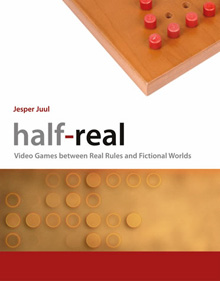
On the plane ride back from DAC 2005 (the second day of which was certainly one of my favorite conference days ever — the papers were great) I read Jesper Juul’s brand new book Half-Real: Video Games between Real Rules and Fictional Worlds (GTxA post, Jesper’s post, book site).

I’m too caught up with my own manuscripts at the moment to write a full review, but suffice it to say that I heartily recommend it. I particularly think it should be used for teaching immediately. It’s a short (~200 pages), well informed, and carefully thought out book. For those already involved in the field it provides good grist: strong arguments and an appropriate framework. For new folks it builds things up from the beginning nicely, showing the current state of the field by demonstration and description, while providing the pointers for further research that one would want.

December 10, 2005

CFP for Human Technology Special Issue: Culture, Creativity and Technology

from Grand Text Auto
by @ 12:09 am

Guest editors: Mark Blythe, University of York; Ann Light, Queen Mary, University of London; Shaleph O’Neill, University of Dundee. Deadline: February 24th 2006.

Advances in interactive computing technology have blurred the line between art, social studies and science. The age of digital reproduction is making radical changes in how art is created, distributed and perceived. Recent work from the humanities and arts has constructively critiqued traditional Interaction Design theory and practice. Studies of experience with technology can provide new insights into the potential of interactivity in contemporary arts and performance, as well as new tools for creativity.

December 9, 2005

The Agrippa Files

from Grand Text Auto
by @ 11:33 pm

Agrippa, small edition Tonight red lanterns are battered, laughing, in the mechanism. The Agrippa Files, a site fashioned as part of it Transcriptions Project at UCSB, has gone online, documenting the 1992 Agrippa (A Book of the Dead) – the 1992 collaboration between artist Dennis Ashbaugh, author William Gibson, and publisher Kevin Begos, Jr.

Read on for news from the press release.

CFP : Video Games and the Alien / Other

from Grand Text Auto
by @ 10:32 am

The University of Florida’s College of Liberal Arts and Sciences is pleased to announce the 2006 UF Game Studies Conference: “Video Games and the Alien/Other,” which will be held in Gainesville, Florida, on April 7-8 2006. Keynote Speaker: Lee Sheldon

CAN YOU SPEAK ABOUT *

from Grand Text Auto
by @ 3:33 am

The ALICE bot developers (Richard Wallace and co.) are making an interesting resource available for purchase: based on 10 years of conversation logs between their award-winning chatterbot and thousands of users, they have compiled a list of ALICE’s most common 10,000 user inputs. (Their bot is in fact comprised of short responses to 4x that number of inputs.) Further, they’ve abstracted this raw data into the top 10,000 patterns of input, which I’d guess is drawn from the top 30,000 inputs or more. This “Superbot” data, in the form of Excel spreadsheets, can be yours for $999.

I actually think that’s a decent value for such data, even if it’s somewhat tied to the general design and interface of ALICE. That is, there’d be all kinds of new inputs users would say that are not on the list, once you make a conversational agent that can have deeper conversations than the very broad but shallow ALICE, or if you made agents with a more focused, less generic domain, such as Grace and Trip in Façade. Still, I’m sure many items on this list would be said to most any bot, at least in this early era of overall bot intelligence.

Speaking of bots and what people say to them, I came across the webpage for an intriguing symposium held at Interact 2005 as well as a sequel to be held at CHI 2006: Agent Abuse, the dark side of human computer interaction. Here’s the symposia’s abstract:

December 8, 2005

Robert Coover on Bookworm

from Grand Text Auto
by @ 9:43 pm

There is a superb interview of Robert Coover available in RealAudio from KCRW’s Bookworm program. The first part of a two part interview was broadcast today, and the other half will be broadcast on the 15th. The first part of the wide-ranging interview provides an overview of Coover’s career and some insights into his process, themes, methods and interest in formal innovation. There are some gems in the interview, such as the fact that Coover finished writing The Public Burning, his novel about the Rosenberg execuations and Nixon, in the British Library while sitting on the same hard wooden benches where Karl Marx wrote The Communist Manifesto.

Brown E-Writing Fellowship Deadline

There’s just one week left to apply for what I believe is the world’s only graduate fellowship specifically for electronic writing (deadline December 15th). It comes with two years of support, three workshops with world-class writers, four other courses at Brown of your choice, and a nice MFA at the end. Last year’s graduate was William Gillespie, and the year before’s was Talan Memmott.

Scott Fisher @Tech

from Grand Text Auto
by @ 2:05 pm

Scott Fisher gave a talk at Tech today on ubiquitous storytelling. Scott’s been visiting Tech for the last couple of days – Ian and I enjoyed a nice dinner out with him last night.

<- Previous Page -- Next Page ->

Powered by WordPress