August 7, 2004

Untitled 5 and More

from Grand Text Auto
by @ 5:18 pm

The revamped site of Camille Utterback, who collaborated with Noah on Talking Cure, offers video documentation of her new, interactive, and “completely algorithmic” piece — that is, one doesn’t use a preexisting image, as Liquid Time does. This new piece is Untitled 5, which will be at Chelsea Marlborough (211 W. 19th St., New York) through September 10.

Networked_Performance, WriteHere, and Intelligent Agent

Turbulence’s new Networked_Performance blog has only been going in earnest for a couple weeks, and it’s already hopping. Head over to learn, contribute, or help plan the 2006 conference (which will be organized by New Radio and Performing Arts, Inc.; Emerson College, Boston; and California State University at Monterey Bay). Meanwhile, Matt Kirschenbaum brings word of WriteHere.net — “a wiki community for creative writers and fiction readers.” My Spring 2003 workshop did some WikiWork, and I’ll be interested to see how such things scale up at WriteHere. Finally, there’s a new issue of Intelligent Agent with essays on copyright, free cooperation, and virtual embodiment. The reviews section also has some reflections on Bang the Machine and GDC from GTxA drinking buddy Adam Chapman.

August 6, 2004

Teaching with Blogs

from Grand Text Auto
by @ 12:00 am

Many people teach with blogs these days, and there are a number of approaches. For example, Liz Lawley’s mt courseware helps one make a cool, faculty-authored blog out of the course website. (A nice example of this in use is Matthew G. Kirschenbaum’s Computer and Text.)

I used blogs with my students in Spring 2003 (I didn’t teach during 2003-04, instead opting for the carefree life of the “Traveling Scholar”). My approach to teaching with blogs was a bit different, organizing the class blogging around a mini-blogsphere (each student having an independent blog, for which the course might be one of many subjects blogged). I’ve never written it up before, but now have in preparation for the Blogging Tutorial that Matt Webb and I are doing in sunny Santa Cruz, CA next week.

August 5, 2004

Selling SMS, CYOA Comics, and Happenin’ Hypertext

In various news… Via Joah, a Chinese author has sold an SMS novel for a pretty penny (especially when you consider how artificially depressed China’s currency is). Via Michelle, on a less-commercial note, the Long Island City-based Flux Factory is currently showing Cartünnel: a comix fluxture — a physical maze of intersecting paths, lined with comics, and created by a group of authors aiming for a “Choose Your Own Adventure” experience. Finally, don’t forget the ACM Hypertext conference next week in Santa Cruz. I’ll be presenting four times — and participants in the Blogging Tutorial will spend a full day hanging out with me and Matt Webb.

Inform from the Beginning

from Grand Text Auto
by @ 2:05 pm

Newcomers interesting in creating interactive fiction, take note: The third edition of the Inform Beginner’s Guide (IBG) by Roger Firth and Sonja Kesserich, edited by Dennis G. Jerz, has just been published. While Graham Nelson’s Inform Designer’s Manual, 4th ed. (DM4) is the essential reference and a good introduction for those with programming experience, the step-by-step, example-based approach of the IBG is sure to be a great help for those less familiar with IF or less experienced as programmers. It’s now been updated for Inform 6.3, a nicely enhanced, bug-fixed, and Glulx-compatible release. The IBG can be downloaded in pdf format; The DM4 is also available in pdf and html.

Secrets of ENIAC

from Grand Text Auto
by @ 12:50 pm

From the series Secrets of ENIAC, by Benjamin Pierce Yesterday I went to the opening reception for Secrets of ENIAC, photographs by Benjamin Pierce, a professor of computer and information science here at Penn. The photographs are extreme close-ups, details of macros, showing a strange industrial landscape within the vacuum tubes of this early computer. They’re now exhibited in Penn’s Levine Hall, home of the CIS department. They can also be seen online.

A special treat was getting to go into the usually-inaccessible shrine called the ENIAC Museum, look at four of the 40 ENIAC consoles from all sides, and up close, and hear from curator Paul Shaffer. The history of computing, and how to assign credit for general-purpose computing, is complex, but ENIAC was the first machine to be able to do a conditional branch (an if statement). The capability wasn’t there from the start; someone (it’s not clear who, but it almost certainly was one of the women who regularly programmed the machine) figured out that a cable carrying a numerical output could be plugged into a control input, so that the program would only continue running on the next console if the output was nonzero. There’s much more to to say, but I’ll point to Penn Special Collections’s nice site to accompany the 1996 exhibit of ENIAC co-creator John W. Mauchly’s papers. In 1996, incidentally, then-Vice-President Al Gore came by for ENIAC’s 50th birthday celebration and flipped on Penn’s remnant of the ENIAC, which counted from 46 to 96.

August 4, 2004

AAAI Game AI Workshop Trip Report

from Grand Text Auto
by @ 2:46 pm

As promised, here’s (finally) my trip report for the AAAI Workshop on Challenges in Game AI. The report is really a bunch of notes I took about the various talks, lightly edited to make them more readable. I didn’t quite manage to take notes for everyone’s talk, but did for most of them. After the workshop, I spent a week on the West Coast visiting a number of game companies (Will Wright’s group at Walnut Creek, the Sims 2 Maxis folk at EA headquarters, and Sony Electronic Entertainment US R&D where Craig Reynolds works) and going to my 20 year high school reunion (“Go Senators“).

Spelunking the British Imagination

from Grand Text Auto
by @ 1:09 pm

I recently found, read, and had mixed feelings about a 2002 article by Julian Dibbell about Adventure, called “A Marketable Wonder: Spelunking the American Imagination.” (Dibbell is probably best-known online for his 1993 Village Voice article “A Rape in Cyberspace…”) The “marketable wonder” refers to Mammoth Cave as a popular attraction in the time of Stephen Bishop, the slave tour guide whose story takes up the first half of the article — and to Will Crowther’s Adventure, which of course wasn’t originally marketed, but later was. The article is addressed to a general, non-computer-fluent readership, which, dear reader, does not include us.

While my writing sense may be tuned for scholarly contexts, there seem to be some issues. Read on…

August 3, 2004

I Will Allow You to Die … Like a Warrior

from Grand Text Auto
by @ 4:39 pm

Shenmue Online screenshot Sega and JC Entertainment (in Korea) have announced Shenmue Online, a MMOG for PC to be set in China in the 1980s. There’s just the one-page press release in English at the official site, but Shenmue Dojo has screenshots in their discussion area. Apparently the project, which has been underway for a while, has a US $28 million budget and is set to come out of beta early next year.

It’s a shame that Sega didn’t let the Dreamcast die like a warrior, and refrained from a U.S. release of Shenmue II so that Sony could have an “exclusive.” (They did the same with Rez.) Ah, well. Your region codes have no killing power…

90% Perspiration

from Grand Text Auto
by @ 3:41 pm

Via Slashdot Games, an article by Michael Labbe with advice for independent / hobbyist game developers on finishing the games they’ve started.

The majority of hobbyist developers imitate big budget development houses. This is an insane undertaking.

[G]ames do not have a successful and vibrant independent underground movement like movies and music. There are no largely successful independents left for beginners to look up to. As a result, the [hobbyist] developers bite off more than they can chew and the work is never completed. … Ultimately, pragmatism is the only thing that matters. If you follow another God, your path may never lead to a finished product.

August 2, 2004

ISEA Zine

from Grand Text Auto
by @ 7:28 pm

ISEA has published a magazine about its upcoming festival and conference (pdf, 3.7MB). Here and there in magazine, in teeny text on skinny sidebars, are lists of people exhibiting art and speaking at the conference, which include several GTxA folk and friends.

July 30, 2004

On Improving the Form

from Grand Text Auto
by @ 1:06 pm

Via our neighborhood ludology blogs, here are links to two articles with ideas on how to improve interactive narrative experiences. First, a new essay by Timothy Burke in which he strongly advocates agency in MMOG virtual worlds.

MMOGs can never be virtual worlds until they abandon the character as the primary unit of persistence. To be virtual worlds, they have to make the gameworld itself the major unit of persistence. … This is the dream of many MMOG players: they beg for gameworlds in which their actions matter, in which there are events of consequence. Developers promise to pursue this chimera, but rarely implement anything even approaching the most modest dreams of players.

Second, an older essay (1989) espousing the concept of game-stories, by Ron Gilbert, veteran developer of adventure games (Monkey Island) and its technology (SCUMM), posted on his new blog. In the essay, which holds up quite well 15 years later (perhaps suggesting how little progress has been made in interactive narrative since then), Gilbert discusses his “rules of thumb that will minimize the loss of suspension of disbelief” in game-stories. Particularly interesting to me, in light of our current experiment in real-time interactive drama, is Gilbert’s rule that “Real time is bad drama”:

July 28, 2004

Post AAAI Workshop

from Grand Text Auto
by @ 8:21 pm

Robin Hunicke has written a post mortem of the just-ended AAAI workshop she co-organized, Challenges in Game AI, which included a keynote from GTxA’s Michael, who promises a conference writeup as well.

Sounds like this successful workshop may take over for the “AI and Interactive Entertainment” workshops that had happened for several years at the spring symposia at Stanford.

Update: Rob Zubek has done a writeup, and Michael just posted a biggie.

The Port from which it Must Start

from Grand Text Auto
by @ 3:05 pm

I just posted a reply on rec.arts.int-fiction (Google Groups access) about how authentic a port of an old interactive fiction game should be. Roberto Grassi posted eight principles for IF porting being used in an Italian project to port IF. The emphasis is on creating, at worst, superset of the original.

This topic is not unique to IF, of course. I also wanted to mention it because of the issue of formal versus material authenticity — how can we make ports of systems not only produce the same output as the original, but do so in a way that at least recalls or is consistent with the material qualities of early interface, and is appropriate for students, programmers, and computer creatives to learn from? I didn’t really write about that issue specifically on the newsgroup, but here’s what I did write…

… the ideal for a port of any classic game, digital artwork, or other important system — if the port is being done to allow people to see what a historically important program was really like — is that the program work exactly like the original. At least, it should work as close to the original as is possible with modern hardware. So, for instance, there’s a “port” of Spacewar that is a PDP-1 emulator running in Java.

July 27, 2004

Views From the Garage

from Grand Text Auto
by @ 5:48 pm

Two new articles have recently come out interviewing advocates of independent game development — one on Armchair Empire with GarageGames co-founder Jeff Tunnell, and one with Jay Moore, “Evangelist” at GarageGames, on Gamasutra.

When asked how game development has changed in the last 15 years, Tunnell replies,

The standard answer here is that games are much harder to create, have larger budgets and larger teams.  I actually call bullshit on the conventional wisdom!  Games are easier to create than in any time in history and they will get easier.  … Making a game is a lot like being in a rock band.  Get together with a couple of like-minded people, learn your different crafts (programming, art, audio), and make a wildly innovative and fun game.  To quote a beaten phrase, “…the world will beat a path to your door.”

July 26, 2004

There Are 3 New Critical Updates

from Grand Text Auto
by @ 12:19 am

The first of these updates from ebr (Electronic Book Review is actually four-in-one: the Game Theories section of First Person, with essays by Henry Jenkins, Jesper Juul, Celia Pearce, and Eric Zimmerman. This section was one of my favorites in First Person, offering some solid ideas as well as provocations.

July 25, 2004

Craig Reynolds’ new Game AI page

from Grand Text Auto
by @ 5:47 pm

I’m blogging from the AAAI workshop on challenges in Game AI. I’ve seen many interesting presentations, and will post a trip report later. But for now, I wanted to post a link to Craig Reynolds’ new Game Research and Technology page. It’s a great resource. He’s just made the page public, and is looking for feedback and suggestions for additional pointers, so don’t be shy about mailing him suggestions for the page.

July 24, 2004

Bloodsport

from Grand Text Auto
by @ 6:51 pm

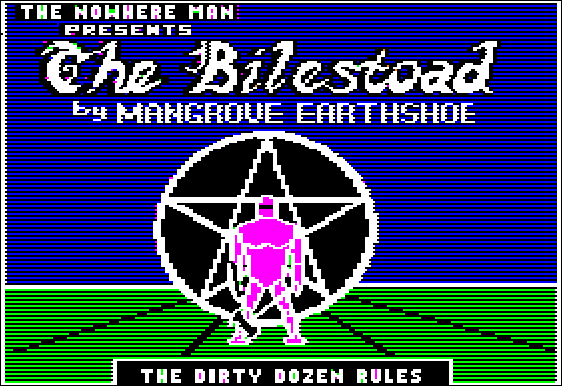
Bit of a Bowman battle Bowman provides all the “Animated Blood” and “Cartoon Violence” (as the ESRB would call it) that I’ve been missing since The Bilestoad. Although I don’t think Bowman offers amputations, as The Bilestoad did.

I enjoyed fidding with the interface for a bit in “Practice” and figuring out how to work it, although perhaps it’s more obvious to some and there will be nothing to learn. Modifying the options can make the game more challenging. Thanks to Allen on ifMUD for the link.

July 22, 2004

Gameblogrolling

from Grand Text Auto
by @ 7:39 am

Gameblogs.org aggregates dozens of game blogs and their latest headlines into one master list, sortable by recent activity, category, and “popularity” (how often people have clicked on a link via Gameblogs.org, I suppose). Find your old favorites and perhaps some new ones, or add your own to the list.

July 21, 2004

Spectropolis

from Grand Text Auto
by @ 10:34 pm

This looks like an interesting event for anyone interested in artistic uses of mobile media Spectropolis: Mobile Media, Art and the City, October 1-3, 2004 is a three-day event that highlights the diverse ways artists, technical innovators and activists are using communication technologies to generate new urban experience and public voice. The event explores what is possible when wireless communications (both new and old), mobile devices and media converge in public space.

Video Games and the Last Election

from Grand Text Auto
by @ 3:59 pm

Meanwhile, another sign of stir crazy things going on at the Gore campaign, Chris Lehane, the campaign press secretary — I am told not directly by Mr. Lehane, but by those who have witnessed this — is playing a video game and vowing to continue to play the same video game until he gets a decision from the Supreme Court.
Jonathan Karl, CNN Correspondent

I’ve been trying to get to the bottom of why those Democrats have delayed Opinions. Bad associations from the past?

July 19, 2004

Computer Games, Fiction’s Future

from Grand Text Auto
by @ 4:28 pm

A source at Brown revealed that GTxA‘s own Noah is speaking tonight on “Computer Games and the Future of Fiction.” Sure enough, it’s the only thing on the university’s events calendar today. The details are that he’s speaking in MacMillan 117 at 7pm — hopefully that time, unlike the spelling of Noah’s name on the announcement, is correct. Here’s the whole series of talks of which Noah’s is one.

Word, Image, Computer

from Grand Text Auto
by @ 3:20 pm

In September 2005, Penn will host Elective Affinities, a conference of the International Association of Word and Image Studies (IAWIS). The deadline for a paper proposal (250-300 words) is this October 1.

One session, mentioned on the conference page but not yet described on the detailed description page, is of particular interest to the pedestrians and gang members here at Grand Text Auto. Here’s the description of that session:

Words on Screen: Hierarchies of Text and Picture in Cyberculture

July 17, 2004

trAce Incubation Trip Report

from Grand Text Auto
by @ 9:57 am

Ted Nelson's ibookI’m just about over the jet lag from a brief jaunt to Nottingham, England for the 2004 trAce Incubation Symposium. While the conference didn’t offer any earthshaking new paradigms, it did prove that Electronic Literature is alive and well in the UK, that Ted Nelson is hyperkinetic as well as hypertextual, and that Alan Sondheim still writes more in a week than most of us do all year long. Incubation was a refreshing and energizing gathering of electronic and print writers, performance artists, and teachers who are using the network in a variety of ways. The food was also quite good and the bar kept late hours for thirsty writers.
July 16, 2004

TIDSE 2004 (part 2)

from Grand Text Auto
by @ 1:42 pm

As promised, here is the long-delayed second half of my TIDSE 2004 trip report.

The second day opened with an invited talk from Ron Baeker, a computer graphics pioneer. He described a new initiative at the University of Toronto: Knowledge Media Design (KMD). KMD are computational media that systematically embody knowledge in a way that encompasses data and process, as well as task space and interpersonal space (social component of tasks and media). The focus is on systems that support human creativity and control, rather than on systems that autonomously generate media artifacts. The best part of the talk was some of the videos he showed of his early work. The first video showed the Genesys animation system that he built in 1966 at the Lincoln Labs at MIT. Genesys allowed users to construct animations by tracing animation paths on a screen. Interestingly, given the discussions on virtual humans at the conference, he did some work in the mid-60s on a system that supported the animation of stick figures. It turned out to be difficult to maintain the constraints between the various parts of the stick figure, so he “moved on to easier problems.” Some of his early projects involved looking at program code as a form of human communication, something which, given all the writing I’ve done on GrandTextAuto about programming as an expressive media, why artists should program, and so forth, I heartily agree with. One of these projects explored the idea of a program book. If software is to truly have a long life, the code should be published as a designed book, with the full source code printed in the book in such a way as to facilitate reading the principles, design decisions, issues, and so forth that are expressed in the code itself. He showed some pictures of The Eliza Book, one of the program books that they made. I’d love to leaf through this book!

<- Previous Page -- Next Page ->

Powered by WordPress