August 15, 2006

Snakes on a Grid

from Grand Text Auto
by @ 11:53 pm

Grid Wars 2

Abstract shooter fans: Be sure to check out Grid Wars 2, programmed by Mark Incitti in Blitz Basic and available for Windows, OS X, and Linux.

The game seems to be the most famous in a series of Geometry Wars clones that use the dual-stick move-and-shoot control scheme of Eugene Jarvis’s Robotron 2084 and radiant vectorized graphics. Grid Wars 2 features a wide variety of geometric shapes along with some snakes. It’s been upgraded substantially since its first release. At World of Stuart you can read some about why the gameplay may exceed that of its visually very similar Xbox progenitor.

August 14, 2006

IF Thesis Writing Time

from Grand Text Auto
by @ 5:00 pm

I just passed my thesis proposal defense here at Penn, which means I get to research and write “Generating Narrative Variation in Interactive Fiction.”

August 13, 2006

Loaded Mazagines

from Grand Text Auto
by @ 5:11 pm
Curio Box

Curio Box 1, Spring 2006, edited by Phillip Dmochowski,
Steve McLaughlin, and Xiaowei Wang

I’m a sucker for issues of literary magazines that take the form of boxes filled with stuff. McSweeney’s 4 (Late Winter, 2000) may be the most well-known recent example. Other bundles in the fairly high production-value, wider-circulation category include McSweeney’s 16 (discussed on GTxA previously) and Wedge 3, 4, and 5 (Winter, Spring, and Summer 1983). I’m not sure who came up with this concept – Duchamp? – but it’s certainly a good one. The format seems to be used in even more interesting ways as one moves from (relatively) well-bankrolled publications to the fringes. The recent Curio Box 1 and Pandora’s Backpages, from a few years ago, offer a zany variety of art and writing in different material forms. These two also incorporate some digital work, and work that engages the digital, alongside print, something that codex-bound literary magazines have found difficult to accomplish.

August 11, 2006

Façade for Macintosh Now Available

from Grand Text Auto
by @ 6:29 pm

Download Façade for Macintosh (131MB) via BitTorrent at interactivestory.net, and spread the word! First time players, please post your feedback here, thanks!

That’s the good news. The not-so-good news is we suspect some of you won’t be able to run it, as it requires at least a 2.0GHz G4 or G5. (Or 1.0GHz dual processors, or 1.8GHz Intel Core Solo.) Several beta-testers ran into this problem.

We’re also working to make it available via direct download at Download.com.

Anyone have any recommendations of what Mac sites we should contact, to get the word out?

ISEA 06 Rocks, Mostly

I’m the only GTxA representative at ISEA this year, and I’m sorry to report that my compatriots are missing a great event. At the Tuesday night kick-off I caught the PigeonBlog release and then saw a really solid show at the San Jose Museum of Art curated by Steve Dietz (Edge Conditions, running through November 26th). Since then I’ve started to see some of the massive collection of art in South Hall (a parking lot covered with a giant tent and filled with digital art), enjoyed a number of live/performative cinema events organized by Ana Serrano of the Canadian Film Centre, seen the “2.0” version of Adriene Jenik’s fascinating SPECFLIC project, and attended the very impressive (if slightly problematic) “3 Data Bodies” by Super Vision. Tonight I’m seeing Mike Figgis do a “live mix” of Time Code and then watching Survival Research Labs bust out their amazing combination of robots, flame throwers, and sound. I really couldn’t be happier with the amount of stimulation I’m getting from the art and events.

Unfortunately,

Games on a Graph

from Grand Text Auto
by @ 1:16 pm

“An Experimental Study of the Coloring Problem on Human Subject Networks” by Michael Kearns, Siddharth Suri, and Nick Montfort was just published in Science. The full text of the article is friendslocked to members of the AAAS, but the abstract explains the basics and a Penn press release offers some further details. The study dealt with “games” in the economic decisionmaking sense, and actually used several different graphs, although “games on six graphs” isn’t as catchy. WoW raiders and others may still wish to take note: The study is meant to shed some light on how, in general, a distributed group of players can solve a common problem together with very limited communication and information, under different incentive schemes and with different network structures.

August 10, 2006

Don’t You Have a Map? Part 10

from Grand Text Auto
by @ 11:06 pm

A traveling essay stops at Grand Text Auto for a visit…

Don’t you have a map?
A collaborative, traveling essay in letters
‘twixt Erika Howsare & Jen Tynes.

Part 10, J to E—

A smelly flower grows in Brooklyn, I send you juttings in the mail. If a poem is going to
Be a thing you’ve got to keep on talking at it? If noticing is going to happen late I’ll see

August 9, 2006

Ill-Fitting Smarty Pants?

from Grand Text Auto
by @ 4:41 pm

Steve Meretzky may see The Escapist as one of the few brights spots in gaming / game criticism these days, but frankly it sometimes misses the mark (1 2). Witness this week’s impressively unnecessary anti-academic tirade. Either the editors are desperate for material, or have a worrisome misunderstanding of how academic study operates. So much for the idea of well-informed journalism.

(Note, my primary gig is not as an academic, so this shouldn’t be interpreted as a defensive statement.)

August 8, 2006

Interactive Drama, a Private Affair?

from Grand Text Auto
by @ 12:02 am

We received an interesting piece of feedback email the other day, and got permission from the sender to post it here:

I’d like to share a little bit about my experience playing Facade in a crowded, privacy-free, communal environment: the frat house. An avid reader of GTxA, I had been following the development and release of Facade closely, but that was most definitely not the case with my brothers. The week it was released, I downloaded it late on a wednesday night, installed it and played through it a couple of times while everyone was in bed. I was engrossed in the story and amazed at the emotional connection I actually felt to the virtual actors.

The next afternoon, I fired it up while my roommates were there and played through a little bit. They noticed and asked a lot of questions about the game. As I played, I noticed my interactions changing to demonstrate not how I would act or how I felt, but what I thought would elicit the most interest from my roommates. “Can I try it?” one asked. Of course.

August 7, 2006

DAC Deadline Extended to August 28th

from Grand Text Auto
by @ 3:49 am

Good news for would-be Digital Arts and Culture presenters who, like myself, are just starting to pull out of the warm crush of summer holiday activities:

Due to a large number of requests, the deadline for 500 word abstracts for
perthDAC 2007 has just been extended to the 28th August 2006.

Full details are at: http://www.beap.org/dac/

Please contact conference chair Andrew Hutchison with any questions
about DAC. a.hutchison@curtin.edu.au

perthDAC 2007 – The Future of Digital Media Culture
7th International Digital Arts and Culture Conference
15-18th September 2007, Perth, Australia.
http://www.beap.org/dac

August 6, 2006

How ACM Sandbox Shaped Up

from Grand Text Auto
by @ 3:38 pm

Jeffrey Howard (whose dissertation on contemporary American fiction, with a chapter on IF, has been discussed on here) sends a report from the ACM Sandbox Symposium, which featured contrasting keynotes by Manifesto Games’s Greg Costikayan and EA’s Ian Shaw; Steve Meretzky’s less than cheerful take on gaming today; and the relevance of the gameplay mechanics of rock, paper, scissors to computer games:

I’ve been at the ACM Sandbox Symposium on Digital Games in Boston last weekend, listening to papers and panels as well as presenting my own paper (“Designing Interpretative Quests in the Literature Classroom.”)

Sandbox was a fun and interesting conference overall, consisting of a mixture of game designers and academicians (about 2/3 of developers to 1/3 academicians)

ZeroOne in the NY Times

from Grand Text Auto
by @ 2:00 pm

Today’s New York Times Art section has an article on locative media projects featured in the ISEA-linked ZeroOne exhibition going on next week in San Jose, California. Projects range from a pigeon blog to a “sci-fi erotic” narrative told over cellphones that unfolds in different paths depending what train route you follow.

August 4, 2006

Beta-Testers Sought for Façade for Macintosh

from Grand Text Auto
by @ 10:05 pm

Mac users that have been patiently waiting for Façade need only wait a few more days — Ryan C. Gordon, our gracious volunteer Mac porting expert (he does this for a living), that we met at IGC05, has just completed a beta build! It took a while, since he only had time to work on it in his spare time, but we hope you’ll agree it’s been worth the wait.

Or, wait even less if you’re willing to beta-test! If you have OS X 10.4.7 or higher, and can download and give prompt feedback on this beta-test version of Façade, please send email to info at interactivestory dot net by end of day Monday, August 7.

Contributions Sought for “Reading Games”

from Grand Text Auto
by @ 1:59 am

Dennis Jerz sent this CFP along to us – it certainly seems like it should interest a few of the Grand Text Auto crowd.

Computers & Composition: An International Journal invites contributions for a special issue, Reading Games: Composition, Literacy, and Video Gaming

While video gaming has been a strong cultural force since the advent of the popular coin-operated arcades of the 1970s, it is only within the last few years that video/computer gaming has been an academic focus: there is a lot of catch-up work to do.

August 1, 2006

Faculty Position at UCSD

I’ve recently joined the faculty of the Communication department at the University of California, San Diego. Having joined, one of my first acts as a member of the faculty was to become part of a search committee — so now I can help bring other interesting people aboard.

Luckily for me, UC San Diego’s not a hard sell. There is much support for digitally-flavored research, including the recently-constructed Cal-IT2 (including a wing devoted to the Center for Research in Computing and the Arts). There are many digital media people on the faculty already, from Lev Manovich to Miller Puckette, from Natalie Jeremijenko to Brian Goldfarb. The grad students are doing great work, including Fox Harrell (whose presentations at DAC and Computational Aesthetics we’ve noted in recent months), Eduardo Navas (of newmediaFIX and other prominent online projects), and the student in my department, Ge Jin, who this spring made a splash with his interviews with Chinese MMO gold farmers. And, of course, there’s the fact that the department is highly interdisciplinary, has a great history of innovative work, and is placed where the weather is supposedly the best in North America.

All that said, the job ad is below. Both areas of focus are of potential interest to GTxA readers, of course, but the “play and communication” area seems particularly fitting.

July 31, 2006

Contour: A Novel Technique for Modeling and Capture

from Grand Text Auto
by @ 4:20 pm

I suppose the big game industry news of the day is the cancellation of the yearly E3 tradeshow (who gives a crap, it was just a big marketing fest), but more interesting is the announcement of a new technology for digitally capturing super-high resolution models and motion of actors, called Contour. See articles in the NYTimes and Wall Street Journal. It’s developed by entrepeneur and inventor Steve Perlman (veteran Apple guy, General Magic, WebTV) and to be demoed at this week’s Siggraph in Boston. See and read more at his website, Mova.com.

July 28, 2006

Cornucopia of Links

from Grand Text Auto
by @ 3:42 pm

The links have been piling up, time to unload… First, interactive narrative oriented links:

More really great links:

July 26, 2006

[giantJoystick] erupts from Game/Play!

from Grand Text Auto
by @ 12:02 am

well, the opening of Game/Play at London’s House of Technology Termed Practice [HTTP] 22nd July was fantastic! This was the premiere of my [giantJoystick] (see below… ah… you can’t miss it)

as well as several amazing screen-based games pieces.

I was impressed with the games in the show,

July 25, 2006

An Infocom Obituary

from Grand Text Auto
by @ 6:35 pm

A short, melancholy article on “The Short, Happy Life of Infocom” is now in The Escapist. The piece is by Lara Crigger, who also wrote the April Compuer Games cover story on IF. Like many such articles, it casusally mentions that Infocom is dead, dead dead dead, not alive. This one is illustrated with a photo of a gravestone, once again following the “IF is history!” formula for such pieces that Jeremy Douglass has pointed out. Why don’t we see articles like “Back Before DOS Bit the Dust,” “Origin Systems: Once Great, Now Toast” or “Dreamcast: Fun, and Six Feet Under!” more often? Or do I just not notice these?

SFU Makes its Move

from Grand Text Auto
by @ 12:48 pm

GTxA’s neighbors to the north at Simon Fraser University are making a move that will shake the academic digital media landscape. This coming season they are hiring six assistant (or possibly associate) professors and four lecturers in Interactive Arts and Technology — which is a very fast scaling up in the academic world, especially for a young field like ours. After this, students and faculty will be ranking digital media programs differently.

The deadline for applications is early: 15 September 2006. The ten positions are:

July 24, 2006

Sandcastle Construction

from Grand Text Auto
by @ 2:00 pm

Tadhg Kelly over at particleblog (whom I recently linked to) has posted a good rant about the “interactive storytelling community’s” misguided notions of the nature and feasibility of interactive stories. In particular he points out that stories are delicate structures, so how can they be made interactive? The age-old question, but I like Tadhg’s take on it.

Please read his full post before reading my comments below, which I also posted on his blog.

July 23, 2006

Serious Games in the NYTimes Arts Section

from Grand Text Auto
by @ 11:59 pm

I get most of my news either online, by radio or PBS TV, but I do indulge in physical delivery of a few magazines and the Sunday New York Times. It seems every third week or so over the past few months, the Sunday NYT Arts & Leisure section has headlined with an article on videogames, a notable new trend of coverage for the paper. Today I opened the paper to find a big spread on serious games by Clive Thompson (whose journalism I blogged recently), leading with a screenshot of Peacemaker developed by CMU grad students, followed on inner pages with several large screenshots of Gonzalo’s Madrid, Sept 12, three (!) screenshots of Ian’s Take Back Illinois, and ICNC’s A Force More Powerful. Plus lots of quotes by all. Very cool! Congrats to all for the great coverage.

July 21, 2006

Place and Space in New Media Writing

from Grand Text Auto
by @ 4:44 pm

I guest-edited a just-released issue of the Iowa Review Web focused on the ways that different forms of new media writing reconfigure concepts of place and space. Another way of looking at the issue, however, is as a Grand Text Auto takeover of Iowa’s finest web journal. The issue features Jeremy Douglass’ interview with Nick Montfort on his interactive fiction Book and Volume and Brenda Bakker Harger’s interview with Michael Mateas and Andrew Stern on their interactive drama Façade. I also interview Shelley Jackson on the various manifestations of the human body in her corpus of work, and interview Jane McGonigal on alternate reality gaming. A short introduction contextualizes the various approaches that authors of electronic literature have used to conceptualize space and place. I hope that you’ll visit, read, and enjoy. Thanks to the authors and contributors and to Iowa Review Web Associate Editor Benjamin Basan for helping to put the issue together.

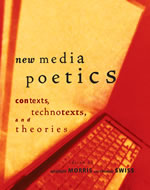
New Media Poetics

New Media Poetics

New Media Poetics: Contexts, Technotexts, and Theories (edited by Adalaide Morris and Thomas Swiss) looks like an exciting new collection. I haven’t seen a copy in person, but the contributor list is great. Here’s some of the jacket text:

New media poetry–poetry composed, disseminated, and read on computers–exists in various configurations, from electronic documents that can be navigated and/or rearranged by their “users” to kinetic, visual, and sound materials through online journals and archives like UbuWeb, PennSound, and the Electronic Poetry Center. Unlike mainstream print poetry, which assumes a bounded, coherent, and self-conscious speaker, new media poetry assumes a synergy between human beings and intelligent machines. The essays and artist statements in this volume explore this synergy’s continuities and breaks with past poetic practices, and its profound implications for the future.

July 19, 2006

GDC07 Abstracts Due July 28

from Grand Text Auto
by @ 2:18 am

It’s an early deadline this year for the Game Developers Conference, which will be in San Francisco again, March 5-9.

<- Previous Page -- Next Page ->

Powered by WordPress