September 26, 2006

E-lit Moves to Maryland

from Grand Text Auto
by @ 11:31 am

ELO attire on displayELO and MITH announcement MITH space

Over the summer, the Electronic Literature Organization (ELO) moved its headquarters from UCLA to the University of Maryland, specifically, to MITH (the Maryland Institute for Technology in the Humanities). This is a great move for the ELO, and I think for MITH as well. As vice president of the ELO, I was one of the people working to help this happen – Scott, co-founder of ELO, and Noah, the other VP of the organization, also put a lot of work into this. And many others did the packing and (literal heavy) lifting to get the office packed up, unpacked, and set up. We’re glad to have helen DeVinney, who is doing her English PhD at Maryland, at MITH as the ELO managing director. We’re looking forward to the ELO being based on the East Coast at its MITH headquarters, and to seeing its national network of activities and events continuing and improving. Check out the press release announcing the move.

Guns with an Agenda

from Grand Text Auto
by @ 12:14 am

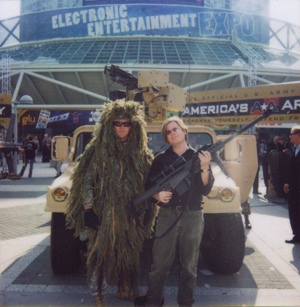
Ian Bogost kicks off his new column — “Games with an Agenda” — with a familiar picture of yours truly toting a rather large rifle. What follows is a thoughtful discussion of the NRA’s game development work and the representation of guns in games generally. The column’s publisher is Serious Games Source, the serious games outlet of CMP’s website Gamasutra. Stay tuned for next week, when Gonzalo Frasca’s column — “Playing with Fire” — debuts in the same place. Gonzalo and Ian will publish their columns on alternating weeks, and the agenda is sure to get heated.

September 25, 2006

I’m Telling You I Was Framed

from Grand Text Auto
by @ 2:28 pm

I was recently interviewed by Simon Mills for framed, his retrospective project of interviews contextualizing digital art and writing between 1998-2004. The interview took shape in the form of several email exchanges over a period of few months. I appreciate the opportunity that Simon gave me to discuss my past and current projects, in addition to sharing my thoughts on the current state of the field of electronic literature more generally.

New Interactive Drama in the Works (Part 1)

from Grand Text Auto
by @ 12:51 pm

Since Façade was released over a year ago, we’ve yet to announce our plans for what’s next. Well, I’m happy to say Procedural Arts has a new interactive drama production underway, for over half a year now in fact. For those interested in the details, here’s Part 1 in a series of posts summarizing what’s been going on over the past year.

After releasing Façade in July 2005 and recuperating for several months, we were ready to begin a new interactive drama production, a commercial product this time, and seek funding for it. The goal is to take what works best from Façade, fix or improve upon what didn’t work, to make a new, more fun, more marketable interactive drama. That is, it won’t be “Façade II”.

Slamdance Indie Game Festival Entries Due Oct 6

from Grand Text Auto
by @ 2:50 am

The deadline for this year’s Slamdance indie games festival has been extended to October 6. Enter your game! The festival is January 19-27 in sunny, snowy Park City, Utah, just outside Salt Lake City.

September 24, 2006

Come out and WIN

from Grand Text Auto
by @ 3:51 pm

It was an intense weekend here in NYC where the Come out and Play Festival 2006 was in full swing. I played game designer Frank Lantz’s IDENTITY game, a game of secret organizations, covert intelligence, suspicion, trust, cooperation and betrayal… upon joining the game, every player is assigned to one of 5 secret organizations and given a unique codename, and the goal was to find out other player’s organizational affiliation and identity…

Writing 3-D

from Grand Text Auto
by @ 2:27 pm

Rita Raley guest-edited the latest release of The Iowa Review Web focused on texts in which three dimensionality is suggested or realized. In addition to Raley’s contextualizing introduction on three-dimensional electronic literature ranging from Brown University’s cave-writing workshop to other forms of writing for complex surfaces, the issue includes interviews and documentation of works by Dan Waber, Jason Pimble, Ted Warnell, David Knoebel, Aya Karpinska, Sandy Baldwin, William Gillespie, and John Cayley.

Web / Print Conceptual Writing

from Grand Text Auto
by @ 11:24 am

2006-05-21 20:52:41   why do i get it
2006-05-21 20:53:24   we the same
2006-05-21 20:54:00   cut my paper off
2006-05-21 20:54:35   no suday paper you came here
2006-05-21 20:55:09   lock your ass out
2006-05-21 20:55:36   laughing
2006-05-21 20:56:30   rick laugh
2006-05-21 20:57:29   joe met his match
2006-05-21 20:58:24   bea laugh
2006-05-21 20:59:05   bea lock you out
2006-05-21 21:00:08   blue eyes
2006-05-21 21:00:44   i cook today
2006-05-21 21:01:36   can cook anything
2006-05-21 21:05:18   home envirronment make a person
2006-05-21 21:06:25   live a happy life

September 22, 2006

Encyclopedia A-E

Encyclopedia A-E

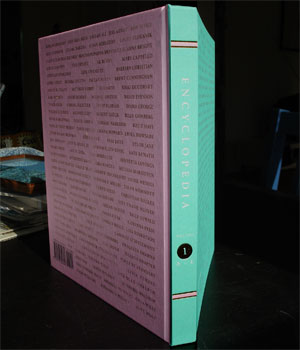
Maybe you read about it in the LA Weekly or The Believer or some other leading edge news source — but now it’s time to experience the world’s finest alphabetically-ordered literary publication first hand. If you live near Providence or Philadelphia, I jealously report that you can attend one of the first launch parties for the Encyclopedia Project‘s stunning initial publication: Encyclopedia volume 1: A-E. The Providence event is this Saturday, September 23rd, 9pm, at AS220. The Philadelphia event is Monday, September 25, 7:30pm, at NEXUS. Even if you can’t make it, scope out your entry for F-K.

September 20, 2006

As Reel as Your Lives

from Grand Text Auto
by @ 11:57 pm

As Real as Your Life

Penn undergrad Michael Highland has a movie coming out on DVD – a short documentary about his experiences as a gamer. It’s called As Real as Your Life. I got to watch it a while back, and it’s great. They liked it at Brown, too. Here’s a trailer, and another.

IF Detected on Book Publisher’s Site

from Grand Text Auto
by @ 11:27 am

Dan Schmidt, IF hero, pointed out that the official site for The Glass Books of the Dream Eaters, written by Gordon Dahlquist and being published by Random House in ten installments, holds a surprise – two surprises. The “online adventure” part of the site contains two promotional pieces of interactive fiction written in Inform: the “Celeste Temple Adventure” and the “Cardinal Chang Adventure.” Mobile play is available, too.

From The Glass Books site

These silicon-driven potential stories are a clever play on the the idea of a glass book and an interesting marketing twist, but I’m still going to keep to my original plan of writing promotional books as a way of getting people to play my interactive fiction.

September 19, 2006

Defining IF

from Grand Text Auto
by @ 9:53 pm

Mara Meijers’s post and three linked blog posts (1 2 3) were mentioned to me, so I thought I’d write a bit about defining IF, and about how a definition of IF (or some other new media form) can help.

I consider “interactive fiction” (or at least “text-based interactive fiction”) to indicate a computer program that accepts natural language input, provides natural output, and simulates a world. An IF system is a conversational system, like a chatterbot – but it simulates a whole environment, incidents, and so on rather than just one personality. So:

  • Interactive fiction, considered from this perspective, is a form (like the sonnet or the sestina) and not a genre (like the mystery).
  • According to this definition, whether something is IF or not has nothing to do with whether it is any good, how much choice it offers, or any other matters of taste or quality.

Hats Off to Airport Securirty

from Grand Text Auto
by @ 8:56 pm

The Arcade Wire: Airport Securirty

As mentioned on Water Cooler Games, Ian Bogost’s Persuasive Games has just released the first in a series of newsgames called The Arcade Wire. The first installment is called Airport Security, and continues to explore Persuasive Games’ overarching theme of people standing in line. It’s pretty funny, too. Check it out!

Yo Mamma Said You Can Come Out and Play

from Grand Text Auto
by @ 2:51 am

Come Out and Play

Festival. NYC. This weekend. Highly ludic. See the site: http://www.comeoutandplay.org/

September 18, 2006

Computer Game Curricula

Last summer an email from Jim Whitehead kicked off an interesting GTxA thread on teaching computer games. Since then, Jim has taught his Foundations of Interactive Game Design and helped launch the new undergraduate degree in computer game design at UC Santa Cruz (where they’ve also recently hired GTxA’s own Michael). I’ve also recently put together a draft of the syllabus for my Fall graduate seminar in computer game studies, where I tried to put into practice some of my thoughts from the conversation we had here last summer.

Recently, in an email exchange with Jim, he and I started talking more concretely about a problem that also came up in our earlier theoretical discussions: getting students access to games. We can’t do what people do with the last generation of “new media” (film and video). We can’t do group showings, because students need to experience the games individually and in small groups. We can’t send students to the library media center, because libraries may be set up for individual experiences of laserdisks, but not game disks.

Hypertextual Excitement on DVD Menus

from Grand Text Auto
by @ 12:14 pm

Memento Flash/HTML/DVD menu thing

Watching Memento again on DVD, I was fascinated to find that the hypertextual police file on the Memento Web site was available not only in Flash and HTML versions, but also on the DVD as a feature. It’s perhaps more interesting as a preliminary set of clues and enticements than an after-movie treat, and doesn’t register as a major 21st century new media effort, but it’s interesting to see that even the non-special-edition DVD that I rented harbored this hypertext.

September 17, 2006

TADS 3 Released

from Grand Text Auto
by @ 10:12 pm

TADS Mike Roberts, who released the original version of TADS: The Text Adventure Development System way back in 1987, posted a wonderful announcement on Friday:

I’m pleased to announce the first TADS 3 General Release, and also a TADS 2 maintenance update.

As long-time raif [rec.arts.int-fiction] readers know, TADS 3 has been in “beta” for quite some time. Well, we’re finally declaring it ready. The official release version is available immediately from tads.org (see below), and has been uploaded to the IF Archive …

This release includes a bundle of documentation, organized into several (virtual) books: Eric Eve’s Getting Started in TADS 3, a tutorial introduction; Eric’s TADS 3 Tour Guide, an in-depth survey of the library, with practical examples of how to use most of the classes; the System Manual, a reference covering the language, run-time system, and compiler and other tools; the Technical Manual, a collection of mostly task-oriented “how to” articles that go into depth on topics of interest to many authors; and the Library Reference Manual, with details on virtually everything in the library and extensive cross-references.

McGonigal Lauded for Technical Innovation

from Grand Text Auto
by @ 7:45 pm

Congratulations to alternate reality gamemaker Dr. Jane McGonigal, who was recently selected as one of the Technology Review 35, a list of innovators under age 35. The Tech Review article about her is online, but the Web version lacks the magazine’s full-page photo-assemblage, done by Polly Becker and showing McGonigal as a marionette in a canister of game apparatus and circuitry.

September 16, 2006

Beall Center Calls for Proposals

The Beall Center for Art and Technology at UC Irvine is a dedicated exhibition space — as well as a producing institution — for art and technology projects. They’ve had exciting game-focused exhibitions, interactive narrative installations, and much more. They’re currently calling for exhibition proposals for 2007-08. The deadline is October 20, and more details follow.

September 15, 2006

Jobs at Georgia Tech and UC Davis

The job ads are coming thick this time of year. Particularly promising ones have just been posted by Georgia Tech (review begins October 15) and UC Davis (review begins November 15).

The Virtual

from Grand Text Auto
by @ 11:19 am

Hi, I’m @ The Virtual 2006 on Rosenön, an island in the archipelago of Haninge, south of Stockholm. Lisbeth Klastrup and I just ran a workshop called “Using the Critical Play Framework: Values in Experience Design” at the conference. The material emerged from my most recent collaborative project concerning values and game design, just funded in the Science of Design program at NSF (hurray!). Most of the conference is focused on developing user experiences; our workshop task was for teams to design a game to get off the island; for the design stage, we assigned the four teams to do their game design with particular human values in mind.

September 14, 2006

Rezvolution / Wiinesthesia?

from Grand Text Auto
by @ 1:13 pm

Confirmed: The Nintendo Wii will arrive in the U.S. November 19, priced just under $250, with Wii Sports and one primary and one secondary controller bundled. (A typical package at a low price, but I wonder: If it’s really for “we,” why not include two controllers of the same type to make the system ready for two-player gaming?) Thirty titles are to be available at launch time.

Rez and Wii? Pure rumor that apparently originated in Electronic Gaming Monthly, but which I can’t resist propagating: A Rez sequel or Rez-like game is in development for the Wii by Tetsuya Mizuguchi. You can read a discussion of Rez in McKenzie Wark’s GAM3R 7H30RY and see the trailer for Rez on YouTube.
September 13, 2006

The Story of Meehan’s Tale-Spin

Most discussions of story generation begin by considering James Meehan’s Tale-Spin (1976) — and deservedly so. Meehan’s project made the leap from assembling stories out of pre-defined bits (like the pages of a Choose Your Own Adventure book) to generating stories via carefully-crafted processes that operate at a fine level on story data. In Tale-Spin‘s case, the processes simulate character reasoning and behavior, while the data defines a virtual world inhabited by the characters. As a result, while altering one page of a Choose Your Own Adventure leaves most of its story material unchanged, altering one behavior rule or fact about the world can lead to wildly different Tale-Spin fictions.

There are two publications that already do a good job of telling us about Tale-Spin: Meehan’s dissertation (The Metanovel: Writing Stories by Computer, 1976) and a chapter in Inside Computer Understanding: Five Programs Plus Miniatures, 1981 (edited by Roger Schank and Christopher Riesbeck). But these sources don’t tell us much about Tale-Spin‘s story. Reading these publications we don’t learn many behind-the-scenes details about Tale-Spin‘s development, or get much sense of the process of Meehan’s work on it.

So, with help from his former student Walt Scacchi, I recently got in touch with Meehan. Now at Google, he was willing to take the time to write up a short narrative of Tale-Spin‘s development. The result was so good that I asked him if I could post it here for the wider GTxA readership, and he kindly agreed. He wrote:

Roger Schank arrived at Yale in the fall of 1974 as a charismatic hot-shot in natural language processing, pushing the idea that everything you know about language is wrong (more or less). Language was not essentially about grammar and other formalisms; language was intertwined with cognition. If I don’t understand what you’re talking about, it doesn’t matter whether I recognize the structure of your sentences. Moreover, if I do understand what you’re talking about, it doesn’t matter whether your sentences are well-formed.

September 12, 2006

Jackson’s Rad Half Life

from Grand Text Auto
by @ 5:29 pm

Half Life... book coverA Review of Half Life: A Novel
Shelley Jackson
HarperCollins Publishers
2006
440 pp.
$24.95

Shelley Jackson puts on a very intriguing and fetching hat or two to write of a conjoined twin in her novel Half Life. Narrator Nora Olney shares much of her spine and all of her limbs with Blanche, who has been slumbering for a decade and a half; these two share their status as a “twofer” with quite a few others in a more radioactive but otherwise similar alternative world. The narrative, which incorporates clippings and lists and has the circuitous wobble of Tristram Shandy, matches its jaded tone to events that are sometimes outrageous, sometimes perfectly true to the typical American experience, and sometimes both. While it takes a while to narrate the conception and birth of Nora and Blanche, the novel is given its impetus by the document that is included first: Nora’s authorization to undergo “The Divorce” and to become an ordinary “singleton” by having Blanche surgically, and fatally, removed.

Perhaps surprisingly, given the overt bodily obsessions and explorations that permeate Half Life (and Jackson’s earlier work – her hypertext Patchwork Girl; her short story collection The Melancholy of Anatomy; her story “Skin,” tattooed on volunteers), it is the spaces and structures of this novel that seem most remarkably compelling and vivid. While the play of the body, Nora’s quest, and her relationship with other characters work well, the landscapes, cities, and towns (along with an intricate and intimate dollhouse) seem to out-strange even the physiognomy of the protagonist. The addition of a twofer scene to San Francisco and London splits these cities from themselves in an uncanny way. Also intriguing are a small Nevada town, Grady, and a nearby place, Too Bad, that hovers on the edge of ghost status, not to mention the desert plot called Penitence with its curious purpose.

Half Life is a deft and deep work; the narrator’s understated, Victorian pen is, oddly, perfectly apt for what is at the core of this book – not sinistrality, politics, or philosophy, which are all certainly to be found among the many layers, but a sense of wonder at human life and the world. Plus, there is a conversation about squid, inadvertent marmite-throwing, and a complete textual delivery of the interrupting cow knock-knock joke.

But it is with more than one twinge that I read Half Life, for I recognized the mapping that Jackson had in mind for her roman à clef. Twofers congregate in San Francisco, where they have film festivals and seek to foster acceptance of their culture. When Nora seeks a clinic for her twin-severing procedure, protesters bar the way and threaten her safety. Important distinctions are found between twofer “pre-ops” and singleton “post-ops.” At the risk of belaboring the obvious, I will unfold the most important correspondences that are intended by the author: Twofers represent authors of electronic literature while singletons signify traditional print authors. Thus, Nora’s quest for “The Divorce” is the story of Shelley Jackson’s forsaking the computer for the book.

September 7, 2006

Two E3 Fantasies

from Grand Text Auto
by @ 10:42 pm
Noah fantasizes America's Army

We can look at games as fantasies. When I play a game I operate in a world in which I have abilities far removed from those in my daily life — whether I’m making gravity-defying maneuvers to slice through sand monsters in Prince of Persia: Sands of Time or making executive urban planning decisions in SimCity, the game lets me act like someone I’m not.

So one question for the game industry is: “Who do gamers want to be?” Tim Schafer points to this as part of the problem that Psychonauts had in the marketplace. Did gamers want the fantasy of being 10-year-old boys?

Most games don’t take such risks, and offer variations on the fantasy of being a gun/sword/spell-toting tough guy. So the question becomes how to present that fantasy. What’s the most effective way of getting gamers to imagine the experience of playing the game will be a good fantasy of this sort? Obviously, it’s not the only question — Psychonauts had good word of mouth both about its fantasy and about its gameplay — but it’s a key question.

This year, at E3, I got to see two organizations with access to exceptional resources offer spectacular answers to this question.

<- Previous Page -- Next Page ->

Powered by WordPress