 Not all playable computational media is graphical. In fact, some of the most popular early computer games were entirely textual. Games like Adventure and Zork were even at times played on teletypes, with the interaction recorded on scrolling reams of paper, rather than on terminals with screens. (Of course, an excellent tracing of the history of this textual interactive fiction can be found in Nick’s Twisty Little Passages.)
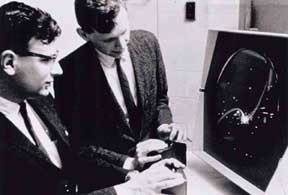
But when we think of playing with computers, we generally think of graphical experiences, those that follow in the tradition of Spacewar! rather than Adventure. Created on the PDP-1 at MIT in the first years of the 1960s, Spacewar! was the first modern video game. Two players each had a custom-made controller, which they used to control the flight of a virtual spacecraft on the PDP-1’s CRT. The spacecraft were pulled toward the star at the center of the screen by simulated gravity, and could fire projectiles at one another. A spacecraft hit by the central star or a projectile would be damaged. These are still among the central logics of graphical gaming today — the ability to move graphical objects that on some level represent the player, the ability to fire projectiles, a simulation of some form of physics, and “collision detection” when one thing runs into another. These logics aren’t only the basis for play in experiences such as Half-Life, but also (leaving aside projectiles) in pieces such as Text Rain.
We’re accustomed to seeing successful combinations of graphical logics and game rules repackaged repeatedly. Games such as Pac-Man and Tetris have had many authorized and unauthorized versions “skinned” with different surface graphics and different graphical arrangements, but with the essential logics of graphical movement and gameplay preserved. Such combinations, within a larger range of variation, are also the basis for our identifications of game genres such as “side-scrollers” and “first-person shooters.”
This is a preview of
Logics People Play
.
Read the full post.



 The latest
  Christiane Paul was
  Just a quick note to try to convince you: please please please stop using those “under construction” icons on your home pages! They are
  Our
Our  This was going to be a comment in